

Updated August 2026
Maryland Wear and Carry permit holders should be aware of an important 2026 update concerning where you can and cannot legally carry a firearm in Maryland.
The ongoing federal case Kipke v. Moore challenges several of Maryland's restrictions on carrying firearms in so-called “sensitive places.” Recent court action has created an unusual situation: some restrictions remain written into Maryland law but currently cannot be enforced.
The Maryland State Police (MSP) has updated its official Prohibited Places to Carry a Firearm guidance to explain the current status.
What Is Kipke v. Moore?
Kipke v. Moore is a federal lawsuit challenging portions of Maryland's firearm carry restrictions, including provisions enacted as part of Maryland's response to the U.S. Supreme Court's decision in New York State Rifle & Pistol Association v. Bruen.
On January 20, 2026, the U.S. Court of Appeals for the Fourth Circuit issued an opinion addressing several Maryland restrictions governing where a person may carry a firearm.
The court upheld restrictions applicable to a number of locations, including government buildings, mass transit, schools and school grounds, state parks and forests, museums, healthcare facilities, stadiums, racetracks, amusement parks, casinos, locations selling alcohol, and areas surrounding public demonstrations.
However, the litigation did not end there.
What Changed in July 2026?
The Fourth Circuit stayed its opinion while the plaintiffs seek review by the United States Supreme Court.
The Maryland State Police updated its guidance on July 10, 2026 to explain what this means for Maryland firearm owners and Wear and Carry permit holders.
According to MSP, while Supreme Court review is pending, the following three restrictions cannot currently be enforced:
- Locations selling alcohol — Md. Code Ann., Criminal Law § 4-111(a)(2)(8)(i)
- Private buildings or property without the owner's consent — Criminal Law § 6-411
- Within 1,000 feet of a public demonstration — Criminal Law § 4-208
This distinction is important: these provisions may still appear in the Maryland statutes, but MSP states that they cannot currently be enforced because of the status of the litigation.
Can You Carry on Private Property in Maryland?
This is one of the most significant issues arising from Kipke v. Moore.
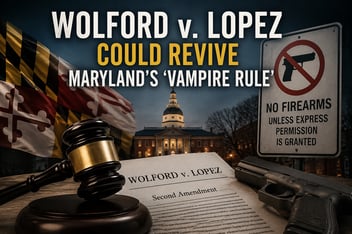
Maryland enacted a restriction generally prohibiting a person from carrying a firearm on privately owned property unless the property owner expressly gave permission or posted signage indicating that firearms were permitted.
This became commonly known as Maryland's “vampire rule” because a permit holder effectively needed to be “invited” before carrying a firearm onto private property.
The private-property provision remains written into Maryland law. However, according to the Maryland State Police's current guidance, Criminal Law § 6-411 cannot presently be enforced while Supreme Court review is pending.
That does not eliminate a private property owner's authority over their property. Property owners can establish rules concerning firearms and can direct an individual to leave their property. Other criminal laws, including Maryland trespass laws, may still apply.
Can You Carry a Firearm in a Maryland Restaurant That Serves Alcohol?
This is another significant development.
Maryland law includes a prohibition concerning carrying a firearm in certain locations licensed to sell alcohol.
According to the Maryland State Police's July 2026 update, the restriction contained in Criminal Law § 4-111(a)(2)(8)(i) currently cannot be enforced while Supreme Court review of Kipke is pending.
Permit holders should not interpret this to mean that every issue involving firearms and alcohol has disappeared. Other laws and restrictions may apply depending upon the circumstances and location.
What Maryland Carry Restrictions Still Apply?
The Kipke litigation has not eliminated Maryland's prohibited-place laws.
Maryland continues to restrict firearms in numerous locations. Depending upon the location and circumstances, restrictions may apply to schools, government buildings, certain healthcare facilities, mass transit and other locations designated by Maryland law.
Because Maryland's firearm restrictions are spread among multiple statutes and regulations—and because litigation can temporarily change whether a particular provision is enforceable—permit holders should verify the current law rather than relying solely on what they learned when they originally obtained their permit.
Check the Official Maryland State Police Prohibited Places List
The best starting point for Maryland Wear and Carry permit holders is the Maryland State Police's current guidance.
Official MSP guidance:
Maryland State Police — Prohibited Places to Carry a Firearm
MSP's page includes its current Kipke v. Moore notice as well as Maryland statutes governing prohibited locations.
Because the case remains active, permit holders should check the page periodically for changes.
What Happens Next in Kipke v. Moore?
The next important issue is Supreme Court review.
Until the litigation is resolved, Maryland Wear and Carry permit holders should pay close attention to updates from the courts and Maryland State Police. A future Supreme Court action—or additional action by the Fourth Circuit—could again change which Maryland carry restrictions are enforceable.
Maryland Wear and Carry Training
Understanding where you may legally carry a firearm is an important part of responsible concealed carry.
Smith Creek Co. provides Maryland Wear and Carry training, Wear and Carry Renewal training, Maryland HQL training, NRA Basic Pistol training, and NRA Personal Protection in the Home training.
Our courses emphasize firearm safety, responsible carry, Maryland law, conflict avoidance and practical skills for responsible firearm ownership.
Disclaimer: This article is provided for educational purposes only and is not legal advice. Firearm laws, regulations, injunctions and court decisions can change. Always verify current Maryland law and official guidance before relying upon information concerning where a firearm may legally be carried.